Ring Size Chart: The Complete UK Ring Size Guide

A ring is on its way to you – or you’re about to choose one. Either way, you’re in the right place with our ultimate guide to ring sizes.
Getting your ring size right is one of those small details that makes a huge difference. Too tight and it won’t go on; too loose, and it might not stay on.
Whether you’re secretly planning a proposal (40% of UK engagements happen between November and February, and Christmas Day is the most popular day of all, according to our UK Wedding Report), shopping together, or just doing your research, we’ve got you covered.
Use our free Bridebook Ring Sizer tool below to find your size in seconds, then keep reading for everything you need to know about measuring at home, converting between international sizes, and nailing the fit.
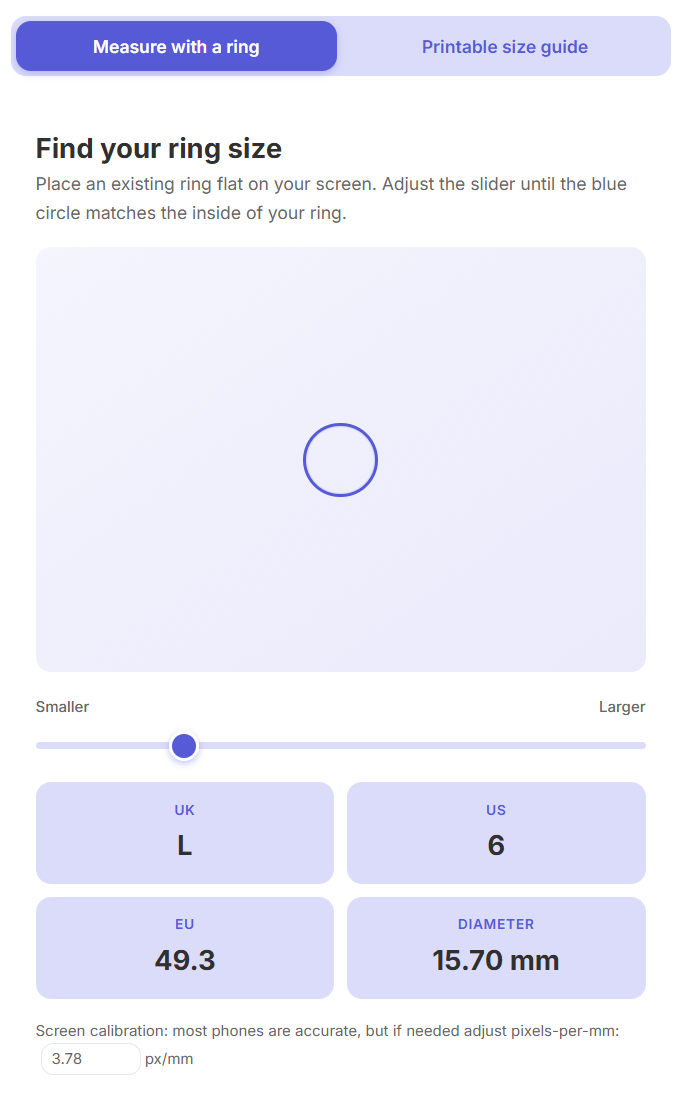
How to Measure Your Ring Size at Home
Good news: you don’t need a jeweller to figure out your ring size. These methods are reliable, quick, and require nothing you don’t already have at home.
One golden rule before you start: always measure in the evening. Fingers are at their largest later in the day, when they’re slightly swollen from warmth and activity.
A morning measurement can be up to half a size smaller – and a ring that fits perfectly in the evening will never feel too tight. If you land between two sizes, always go up.
Method 1: The Paper Strip Method
You’ll need: a thin strip of paper, a pen, and a ruler.
- Cut a strip of paper approximately 10cm long and 1cm wide.
- Wrap it snugly around the base of the finger you want to measure – for most people this is the ring finger on the left hand.
- Mark the point where the paper overlaps with a pen.
- Lay the strip flat and measure the length in millimetres from the end to your mark.
- Find your measurement in the circumference column of the size chart below to identify your UK ring size.
Method 2: The Existing Ring Method
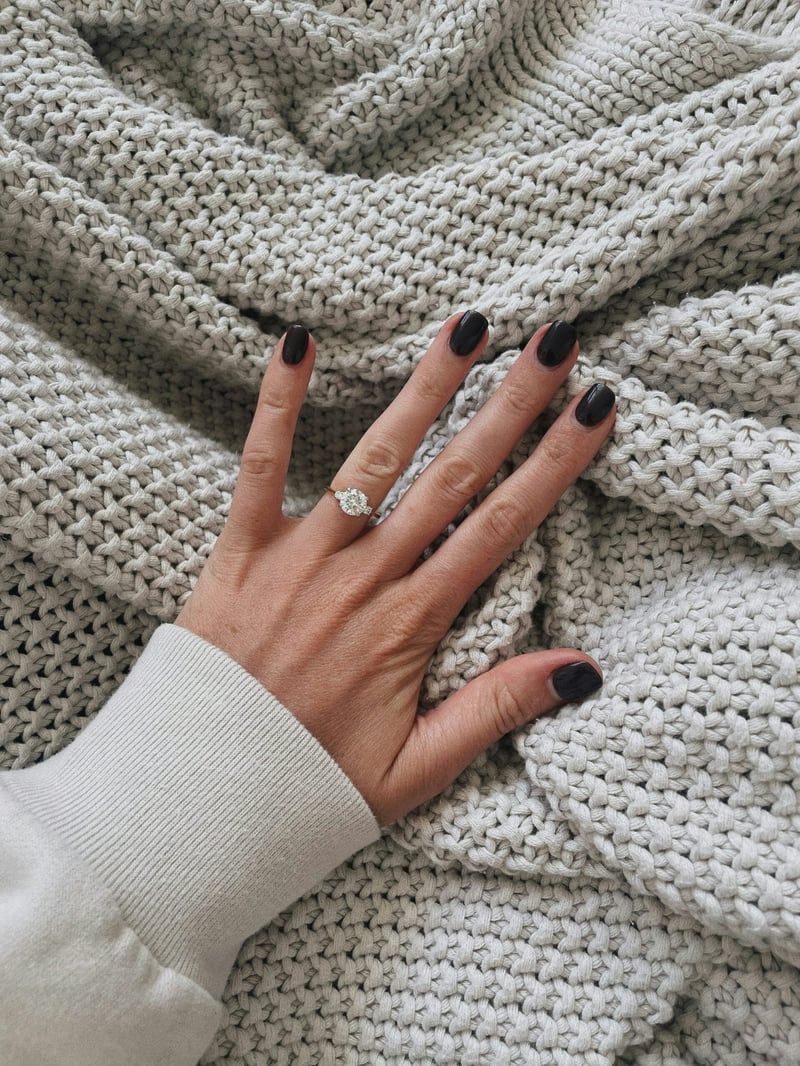
You’ll need: a ring that fits the correct finger, and a ruler.
- Place the ring on a flat surface.
- Measure the inner diameter of the ring in millimetres – this is the distance across the inside of the ring, not the outside edge.
- Find your measurement in the diameter column of the size chart below.
Planning a surprise proposal? This is your method. Borrow a ring your partner wears on their ring finger – even for two minutes – and you’ll have everything you need. According to Bridebook data, the average UK couple spends £2,247 on an engagement ring, so it’s worth getting this right.
Method 3: The Soap Bar Method
Again, another secret ring sizing method. You need a ring and a bar of soap.
- Press the ring into the bar of soap – twist slightly if needed, to create a clear indent in the soap.
- Clean off the ring and don’t leave any trace of soap (make sure the plug is in the sink; you don’t want to drop it!)
- Take the soap bar to a jeweller, so they can see the ring size.
Method 4: The Candle Method
A bit less messy than the soap method, the candle method is great if you’re trying to secretly find out your partner’s ring size, and you can’t steal one of their rings to take to a jeweller.
You’ll need a tapered candle and a ring.
- Get a long-tapered candle, and your partner’s ring.
- Slide the ring down the candle and twist it when it can’t go any further to leave an indent on the candle.
- Take the candle to your jeweller so they can see which ring size it matches up to.
UK Ring Size Chart
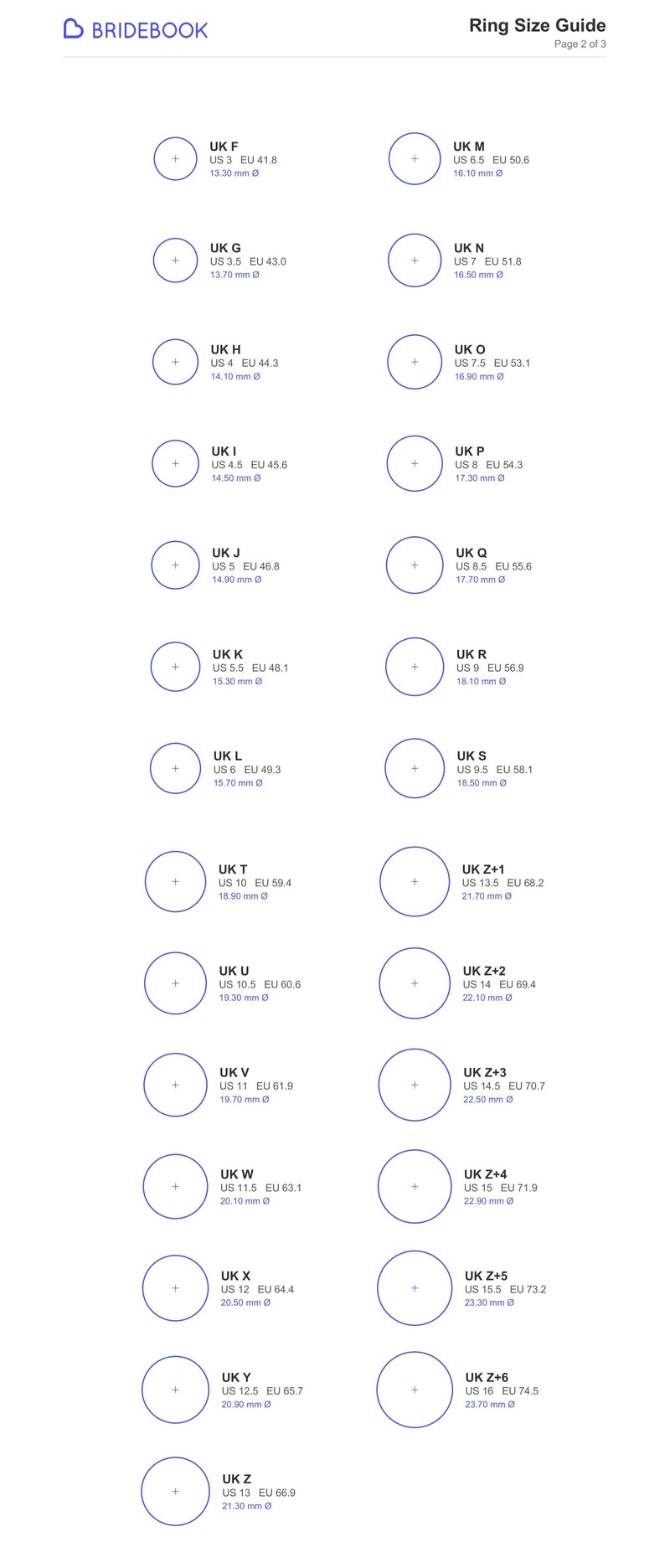
Ring Size Conversion Chart: UK, US, & EU
Whether you’re buying from a UK jeweller or shopping internationally, this chart has you covered. You’ll see that the UK uses letters, the US uses numbers, and the EU uses circumference in millimetres. All measurements follow British Jewellers’ Association (BJA) standards.
Note that sizing can vary slightly between individual jewellers, so if you’re ever in doubt, ask for a professional fitting before you commit.
UK Size | Diameter (mm) | Circumference (mm) | US Size | EU Size |
F | 14.1 | 44.2 | 3 | 44 |
G | 14.5 | 45.5 | 3.5 | 45.5 |
H | 14.9 | 46.8 | 4 | 47 |
I | 15.3 | 48.0 | 4.5 | 48 |
J | 15.7 | 49.3 | 5 | 49 |
K | 16.1 | 50.6 | 5.5 | 50.5 |
L | 16.5 | 51.9 | 6 | 52 |
M | 16.9 | 53.1 | 6.5 | 53 |
N | 17.3 | 54.4 | 7 | 54 |
O | 17.7 | 55.7 | 7.5 | 55.5 |
P | 18.1 | 57.0 | 8 | 57 |
Q | 18.5 | 58.3 | 8.5 | 58 |
R | 18.9 | 59.5 | 9 | 59.5 |
S | 19.4 | 60.8 | 9.5 | 61 |
T | 19.8 | 62.1 | 10 | 62 |
U | 20.2 | 63.4 | 10.5 | 63.5 |
V | 20.6 | 64.6 | 11 | 64.5 |
W | 21.0 | 66.0 | 11.5 | 66 |
X | 21.4 | 67.2 | 12 | 67 |
Y | 21.8 | 68.5 | 12.5 | 68.5 |
Z | 22.2 | 69.7 | 13 | 70 |
Z+1 | 22.6 | 71.0 | 13.5 | 71 |
Z+2 | 23.0 | 72.3 | 14 | 72 |
Average Ring Sizes in the UK

If you’re buying a ring as a surprise and measuring isn’t possible, these averages are a useful starting point.
The average ring size for women in the UK is L to N. For men it’s T to V. These are starting points, not guarantees (fingers vary enormously and there’s no such thing as a “standard” hand). Always check the jeweller’s resizing and returns policy before you buy.
Worth knowing: most rings can be resized in one or two sizes in either direction without any issue. The exception is eternity rings and full-pavé bands where stones run all the way around – these are extremely difficult to resize, so accurate measurement matters even more for those styles.
Tips for getting the right fit
A few things that can affect your ring size that are genuinely worth knowing:
- Temperature; Fingers shrink in the cold and swell in the heat. Don’t measure your ring size on a winter morning or after a hot bath. In the evening, at room temperature is your sweet spot.
- Time of day: As above, always measure in the evening rather than in the morning.
- Dominant hand: Your dominant hand is typically half a size larger than your non-dominant hand. If you measure your right hand but wear your ring on your left, account for that.
- Pregnancy and weight changes: Ring size can change significantly during pregnancy and with weight fluctuation. If either applies, wait until things have settled before committing to a non-resizable style.
- Knuckle size: If your knuckle is noticeably larger than the base of your finger, size for the knuckle and have the ring fitted with a sizing bar inside the band to stop it spinning. Most jewellers offer this as a low-cost adjustment.
Ring Sizes FAQ
What is the average ring size for a woman in the UK?
The average ring size for women in the UK is between L and N, with N being the most cited average.
If you’re buying a surprise engagement ring and can’t measure, N is a reasonable starting point, but always check the resizing policy.
What is the average ring size for a man in the UK?
The average ring size for men in the UK is between T and V. Men’s ring sizes vary more widely than women’s, so if you can get any measurement at all – even an approximate one using the existing ring method – it’s worth doing.
Can ring size change over time?
Yes. Ring size can change with age, weight fluctuation, pregnancy, temperature, and even the time of day.
If a ring you’ve worn for years suddenly feels tight or loose, it’s worth getting professionally measured again rather than assuming your size hasn’t changed.
Should I size up or down if I’m between sizes?
Always size up. A ring that’s slightly loose is far easier to resize than one that won’t go past your knuckle. For wide bands specifically, go up at least half a size as wider bands fit tighter than narrow ones.
How do I measure ring size secretly for a proposal?
The easiest method is the existing ring method; borrow a ring your partner already wears on their ring finger (even briefly while they’re asleep or in the shower) and measure the inner diameter with a ruler.
Alternatively, trace the inside of the ring onto paper and bring that to the jeweller. If all else fails, buy the most likely size, choose a jeweller with a clear resizing policy, and plan to get it adjusted after the proposal.
What is a UK size L in US ring sizes?
UK size L is equivalent to a US size 6, with an inner diameter of 16.5mm. Use the full conversion chart above for all other size equivalents.
What is a UK size N in EU ring sizes?
UK size N converts to a EU size 54, with an inner diameter of 17.3mm. If you’re buying from a European jeweller, it’s worth checking the diameter alongside the EU number, since EU sizing is based on circumference in millimetres rather than a letter or number scale. Use the full conversion chart above for any other UK-to-EU equivalents.
How do I convert my UK ring size to a US ring size?
UK ring sizes use letters, while the US uses numbers – a UK size L, for example, is a US size 6. The simplest way to convert is to find your UK letter in the chart above and read across to the matching US number. If you only have a diameter or circumference measurement in millimetres, you can use that directly to find your US size without needing to work out your UK size first.
Ready for the next step?
Now you know your size, the exciting part begins. Bridebook connects you with trusted jewellers and engagement ring specialists across the UK, alongside everything else you need to plan your wedding from proposal to reception.
Sign up now and get ready to plan your wedding!

Why Trust Bridebook
Bridebook is the world’s #1 wedding planning platform, used by over 2.8 million couples. Our content is informed by real data from the Bridebook UK Wedding Report, which draws on responses from thousands of couples planning their weddings each year. Where expert input is included, contributors are named and their credentials verified. We update our articles regularly to ensure prices, statistics, and advice reflect current market conditions.
You Might Also Like…
- Your Ultimate Wedding Planning Checklist: Every Step from Engagement to Wedding Day
- Wedding Budget Breakdown: How to Allocate Your Wedding Budget
- How Much Does a Wedding Cost in the UK?
- Hidden Wedding Costs Every Couple Needs To Know About
Related articles